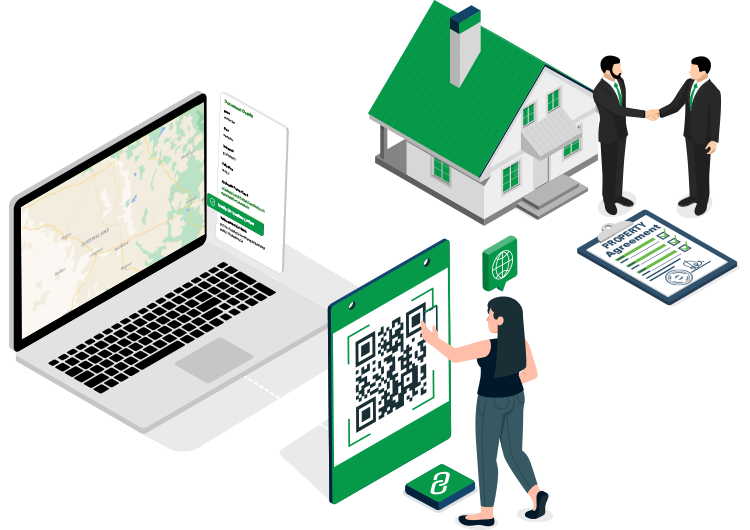
The Ultimate Blockchain-secure Solution To Buy, Sell & Manage Real Estate Properties.
Now list, buy, sell & verify real estate properties like never before using the security of blockchain technology!
*No credit card required
Less than 15 minutes
median turnaround*
Technology
blockhain secured
99.9 %
uptime SLA
REST API
for custom flows
Take a 2-Minute Interactive Tour
See how VeriSettle transforms real estate workflows—walk through listing, document upload and blockchain verification in just minutes.
verisettle.com.au
Quick Tour
See how VeriSettle works
Why VeriSettle?

Without VeriSettle
- No guarantee of property or real estate agent legitimacy.
- No scope to verify the property paperwork.
- Easy to fall under the influence of fraudsters and get scammed.
With VeriSettle
- Easy to list properties and property documents all on the same platform.
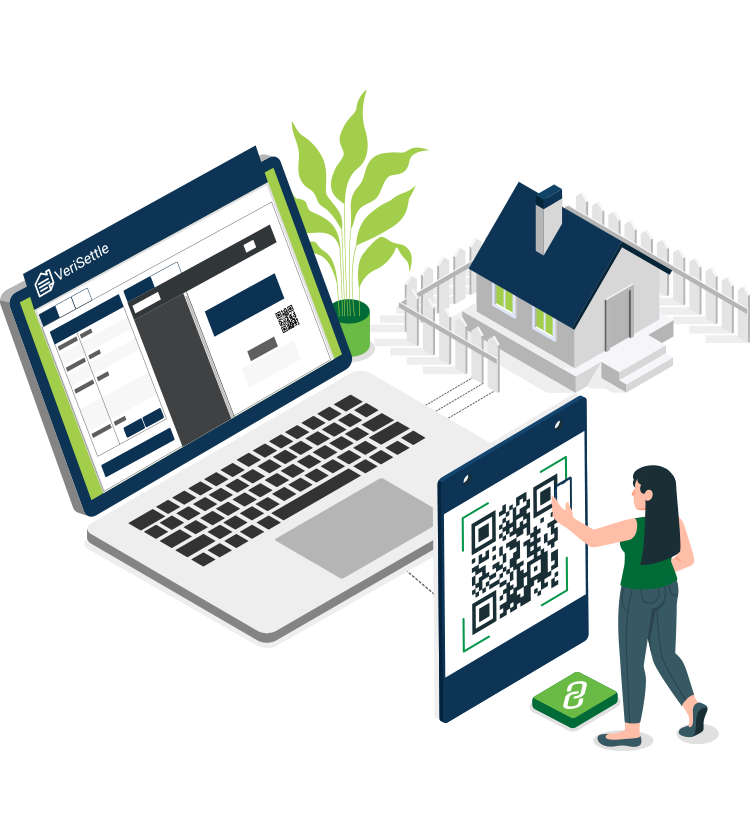
- Simple QR scanning to verify the legitimacy of property documents.
- All transactions are transparent and stored on the blockchain.
Why Teams Choose
VeriSettle
List Multiple Properties
Individual agents can list multiple properties for buying/selling without the trouble of physical interactions or offline paperwork.
Invite People
Now invite the required people like buyers, sellers, visitors, builders, etc. to check out a listed property or verify necessary property-related documents.
All-in-one Property Management
VeriSettle ensures that all property-related documents are completed (including uploading eSignatures wherever needed) and that required people are updated and given the right access.
Connect Your Stack in Hours
How It Works — 3 Simple Steps
Streamline property listing, verification and management in three clear steps
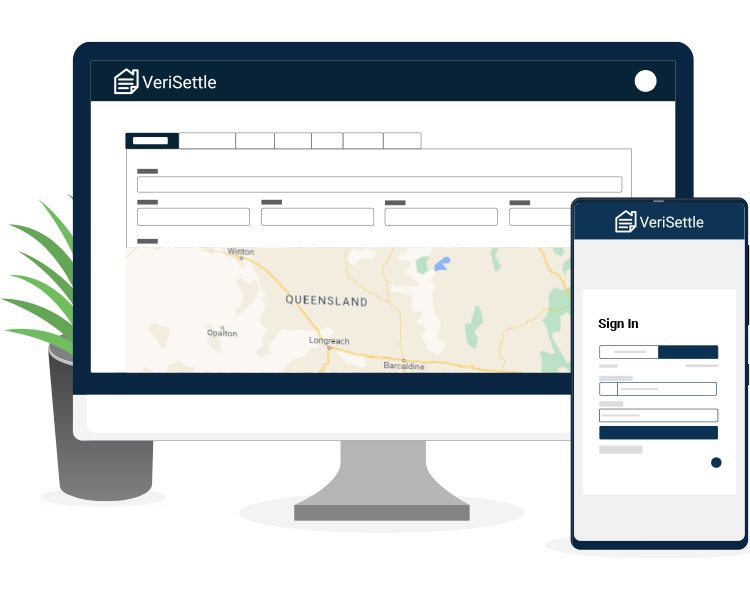
- List Properties — Create unlimited property profiles with address, floor-plan, photos and description in one place.
- Invite Stakeholders — Add buyers, sellers, agents and contractors for document-sharing and collaboration within your workflow.
- Verify & Manage — Store all property-related documents on the blockchain, embed QR codes for instant proof and access a secure audit trail anytime.
Transparent Property Listings
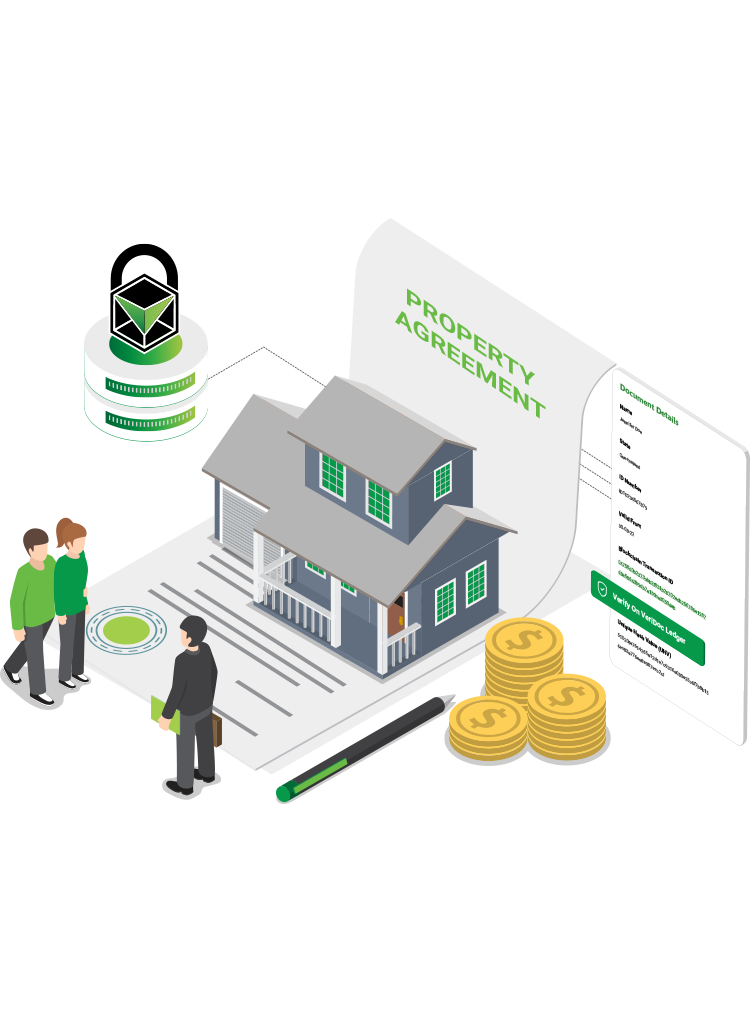
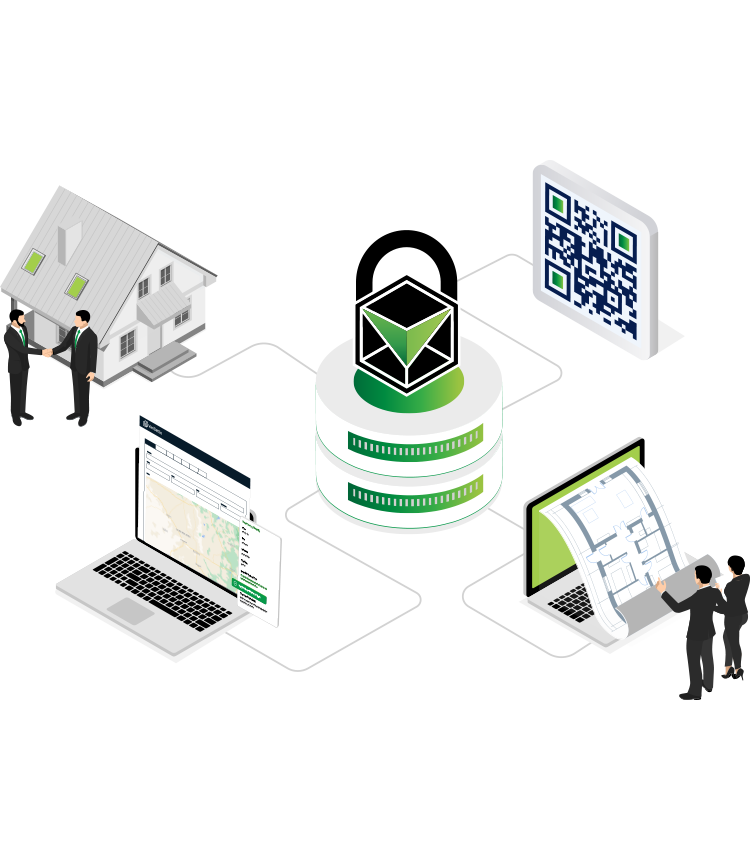
Add your property details — including title, address, photos, and documents. VeriSettle securely locks this information on the blockchain, ensuring it remains tamper-proof and permanently verifiable.
Optional Power-Ups:- Pre-populate property fields using our REST API / SDK.
- Save commonly used property templates so you can create verified listings in seconds.
No hidden fees, no storage charges—just one flat plan per property with blockchain verification included for every listing.
Verify Instantly
Once your property records and documents are uploaded, VeriSettle automatically generates a unique blockchain-secured QR code for each file. Anyone with access can scan the QR code using any smart device to instantly confirm authenticity and data integrity.
While verification is active you can:
Green badgeVerified – Record has been authenticated successfully.
Grey badgePending – Verification in progress or awaiting confirmation.
Re-verifyTrigger a quick blockchain re-check anytime to validate document status.
Share & Track
After verification, securely share property records or QR codes with buyers, sellers, and agents. Each interaction is recorded on the blockchain, giving you complete transparency over who accessed or viewed your documents.
- Downloadable blockchain-backed reports
- Generate downloadable blockchain-backed reports for audits or
compliance reviews.
- Generate downloadable blockchain-backed reports for audits or
- Track document status
- Track document status, access logs, and verification history in real time.
That’s it — Create → Verify → Track — transactions simplified, transparency ensured, and trust permanently secured.
Simple, Predictable Pricing
Transparent pricing with no hidden fees — pay only for what you use, with clear, predictable costs every time.
Considering VeriSettle?
solution for your property management needs.
Beyond Ordinary Solutions
- VeriSettle makes every property process transparent and secure with blockchain-powered validation.
- Stored information is fully tamper-proof and immune to manipulation.
- A verifiable QR code for instant legitimacy checks.

Frequently Asked Questions
Benefits of SaaS for Customers and Businesses
Customers can benefit from SaaS businesses in a variety of ways, such as finding a ride or a song they like, hosting massive amounts of data, or running multiple field agents. There are numerous advantages to using SaaS for businesses, including lower upfront costs of commercial software, the elimination of the need to install software on individual machines, service scalability with business growth, integrations with popular software, and prompt updates to all users.
Expert Considerations Before Adopting SaaS
Here are some expert guides you need to keep in mind before adopting any SaaS service: As they are supposed to be designed with best practices at the core, SaaS applications should be user-friendly. Look for options that allow you to first demo and test the software, for free. When allowing a SaaS service provider to maintain your sensitive data, one of the most important factors to consider is data security. However, the practice of doing everything online has resulted in strict security and safety parameters.
SaaS as a Competitive and Cost-Effective Solution
In the last five years, SaaS has become an extremely competitive space, driving down prices and allowing you to shop around for a price that fits your budget. SaaS should provide any business, but especially small and medium-sized businesses, with the benefits of traditional software at a lower cost-benefit ratio. Organizations can enjoy the advantages of SaaS solutions that many in the private sector already know, such as increased savings, improved data collection, increased team efficiency, sustainability, and greater adaptability in service delivery.
QR Code Verification for Blockchain Documents
With the rise in cyber security concerns and data breaches, most reputable organisations utilise QR verification to check the authenticity of documents stored in the blockchain. Scanning a secure QR code starts a real-time sequence of technology-based verification steps. This includes ensuring that the original document stored on Amazon S3 has not been edited or tampered with.
Globally Patented Verification Protocol
To verify the authenticity of a document, the globally patented verification protocol uses the unique digital fingerprint of a document, also known as a unique hash value. This ensures that any confidential or sensitive contents of a document are always protected and that GDPR and other privacy standards are met.
Tracking and Placement of QR Codes
The QR code authentication ensures that you can track all of your users’ and viewers’ activities on any uploaded document. Depending on your preferences, you can place the QR code anywhere on the document. We recommend placing the QR code near the top of the first page so that anyone looking to verify the contents of any document can easily find it.
Importance for Businesses
Businesses use blockchain verification with QR codes to determine the legitimacy of documents, certificates, payments, contact information, and much more. If your company does not use QR codes for validation, you will undoubtedly fall behind.
Why Global Organisations Are Adopting SaaS
Today, even the most prestigious global organisations are opting for SaaS solutions because of their convenience, performance, and transparency. But before you delve into the world of SaaS or even consider adopting SaaS solutions in your regular workflow, you need to fully understand the SaaS best practices. Let us have a quick look at some of the most vital ones.
Control and Management of Access
Only those with the necessary permissions have access to appropriate cloud applications. SaaS providers should consider using additional security features such as 2-factor authentication or other more robust authentication methods.
Monitoring SaaS Usage
Frequent updates, like any other type of technology security, are critical. As a result, SaaS providers must keep their standardised Virtual Machine (VM) images and software up to date, as well as monitor and track all SaaS usage.
Data Security
Users interact with SaaS applications through a variety of established channels. These channels must be encrypted and secured with other security tools to keep all data safe from illegal access.
Migrating to SaaS
Migrating your systems and processes to SaaS is a wise decision. But first, you must consider both your organization’s existing requirements and SaaS-specific security requirements.
Blockchain-Enabled SaaS Solutions
Our SaaS products adopt blockchain technology to provide data transparency and data security to all our users. Our expert-designed SaaS solutions use VeriDoc Ledger, our very own blockchain designed with governments and enterprises in mind. VeriDoc Ledger is a fork of the Ethereum blockchain, enabling the ledger to inherit seven years’ worth of blockchain development and smart contracts capability. The credibility and track record of the second-largest blockchain in the world influenced the company’s decision to use Ethereum as the foundation for its technology.
Transparency and Trust with Blockchain
Blockchain is completely transparent. Once you make a transaction in the blockchain, it cannot be changed or tampered with. And the transactions are encrypted using cryptography. The transactions are transparent. Thus, it proved to be the perfect solution for trust issues. Blockchain helps you share data within an ecosystem of businesses. So, there is no single entity. This way, you can make a deal or share data without having to worry about it getting leaked. Blockchain establishes trust between individuals, even when it is non-existent. So, now you do not have to share data anymore. The transaction is transparent.
Reliable Data Security and Verification
No matter what solution you choose from us, you can always be assured of our blockchain technology to provide the best transparency, protect and store data without any hassle, and make verification as easy as possible, every time.
Expertly Designed SaaS Solutions
All our SaaS solutions are designed by well-experienced experts who pay extra attention to make them secure and transparent. Nowadays, the software-as-a-service (SaaS) model is becoming increasingly popular among businesses. Organisations and consumers are turning to SaaS for its convenience and other benefits as internet connections become faster and more reliable.
Advanced Data Security Measures
Our SaaS solutions utilise various measures to provide the most reliable source of data security. This includes:
Utilising blockchain technology (patented in over 90 countries worldwide) to store data and documents.
Employing the highly secure Microsoft Azure Cloud Solution for ultimate data security.
Access customisation where the admin can differentiate private and public documents, providing admin access and viewer access accordingly.
QR codes on all generated documents to make verification simple, so concerned individuals can easily scan the secure QR code from any smart device to check the legitimacy of the required document.
Reliable Backups and Security Practices
In light of recent major data breaches, data security deserves special attention. SaaS can be far more secure than on-premise applications with the right technology and best practices. Furthermore, good SaaS platforms create backups of customer data on a regular basis. If anything happens to the data stored on local devices, backup copies are available online at any time and from any location.
Focus on Core Business with Confidence
Organizations can benefit from the data security experience, expertise, and advanced technologies of SaaS providers by incorporating them into their regular workflow. Businesses can devote their time and resources to more pressing issues while knowing that their data security is being handled expertly.
Flexible Subscription Plans
Not at all! Our SaaS solutions, from electronic signature to certificate management software, come with the option of monthly as well as annual subscription plans. Both plan offerings are all-inclusive and do not require any extra or setup charges. Both our monthly and annual plans are very cost-effective and can be utilised by small, medium, or large enterprises to implement in their workflow.
Customisable Plans
All of our solutions offer customisable plans that you can utilise according to the number of users by talking with our sales representatives directly. Most of our popular SaaS solutions also come with free trials that you can opt for before purchasing any of our Standard, Pro, and Advanced plans. The free trial comes with all the features and benefits of the particular solution, allowing you to familiarise yourself with our simple user interface and explore the advantages before buying.
Flexible User Options
All our plans come with a fixed number of users but can be made flexible by adding more users if needed, with a discounted charge.
No Hidden Costs
We never charge any additional costs like setup or software update charges. Once you have purchased any of our affordable subscription plans, you can enjoy all the features and benefits for the duration of your subscription. We also believe in not wasting any resources, so any extra envelopes (in the case of our eSign solution) or any extra certificates (in the case of our certificate management solution) that the user couldn’t utilise are rolled over to the following month of subscription.
Free Trial Availability
Absolutely yes! We offer a wide variety of popular SaaS solutions that come with a free trial option. Our free trial has attractive features and benefits that you can easily try before committing to a paid subscription plan. By opting for our free trials, you do not need to pay anything or share your private debit/credit card details. This ensures that our customers can take full advantage of our product without worrying about data privacy or any possibility of fraud.
Extended Trial Period
For our clients’ benefit, our free trial period lasts longer than most of our competitors. The main reason for this is that we want our customers to become fully familiar with our solution. A longer free trial period also allows you to try out our attractive features and benefits and the simple, user-friendly interface before making any financial commitment. You can also check out the benefits our solution can provide to your organisation or business. This way, when you ultimately decide to buy a subscription, you know exactly what you are getting.
Advantages of a Free Trial
In summary, here are the advantages of a free trial for SaaS solutions:
You can easily check the compatibility of the software with your organisation’s workflow.
The concerned employees can also try out the solution for themselves.
Understand the overall offerings of the product.
Determine whether the solution will smoothen your current workflow or not.
Check if it requires any prior technical knowledge.
Evaluate how this particular solution is different and whether it offers more features than other solutions of the same kind.
Introduction to Blockchain Technology
At the moment, blockchain technology is one of the most popular and exciting technologies. Although most people know the term, they don’t fully understand what it means. After understanding the features of blockchain technology, you will have a clear idea of what blockchain is.
Increased Capacity
Blockchain technology is remarkable for increasing the capacity of the whole network. Many computers working together offer more power than a few centralised devices.
Better Security
The lack of a single point of failure makes blockchain technology more secure than its contemporaries. As blockchains are distributed throughout a network of nodes, the integrity of the original data is never compromised, even if one node fails or is hacked.
Immutability
Blockchain is based on the concept of creating immutable ledgers. Since a centralised database relies on some third-party intermediary to ensure its security, it is prone to hacks and frauds.
Faster Settlement
Banks are notoriously slow due to the lengthy settlement process, which usually takes days. Blockchain can solve this problem by settling money transfers at super-fast speeds. Ultimately, this saves time and money for these institutions and provides convenience to consumers.
Understanding the Benefits of Blockchain Technology
Understanding the benefits of blockchain technology is immensely helpful in determining if it will benefit your business. From there, you can see how it’s changing many niches around the world. You may be surprised where it could go in your niche. Multiple benefits of blockchain technology for businesses include cost reduction, a reduction in intermediary time consumption, and an enhancement of ecosystem trust.
Blockchain and Digital Payments
The collaboration of blockchain and digital payments is an obvious application of decentralised blockchain networks. By removing the involvement of third parties and associated documents like billing statements and invoices, blockchain has also eased the cash flow in startups and establishments.
Eliminating Middlemen in Contracts
Being part of a blockchain eliminates the necessity of a middleman for various contracts. The technology offers an immutable record, identity verification, and the ability to establish binding terms. You cannot delete blockchain records, and everyone has a timestamp.
Metadata and Auditing
You can even add extra metadata options to blocks for auditing purposes. It’s a wonderful way to show the history of your files or transactions whenever you need it.
Innovation Potential
Blockchain is still evolving, so there is much room for innovation. Perhaps you need a feature not listed, or your company wants to start its own blockchain program with custom fields. Those are all still viable options.
What is the SaaS Model?
The premise of the software-as-a-service or SaaS model is that a piece of software is hosted on a cloud infrastructure (i.e., operated through a web browser), and businesses pay a monthly fee to get access to this software.
Development Requirements for SaaS
It often takes a good amount of coding knowledge, combined with strong user interface design skills, to really make a SaaS product worthwhile. As you can imagine, this is incredibly attractive as a service.
SaaS as a Cost-Effective Solution
Business owners who do not want to invest huge sums of capital in creating an IT infrastructure often use a SaaS solution. That SaaS solution often becomes integral to their business – such as sales teams using Salesforce or customer service departments using Zendesk.
Client Benefits of SaaS
The SaaS business eliminates risk for the client, who usually only pays a small monthly membership fee. Users can access and use the software from almost any device. Generally, the users pay a recurring subscription fee to have access to the software.
Customer Loyalty in SaaS
The beauty of the SaaS business model is that your customers can become extremely loyal to your product. This is especially true if your SaaS product is integral to their business operations. Users essentially become “members” of a service ecosystem, relying on it for day-to-day work.
Key Advantages for Target Customers
A SaaS business model favours your target customers by minimising costs and increasing product usage flexibility. The key benefits include lower costs, flexibility and scalability, quick benefits, and higher adoption rates.
Understanding SaaS Customizations
You’ve likely looked into customizations if you’ve invested in SaaS products. The term can describe any enhancement, modification, or extension that was not prebuilt by developers and instead required custom coding.
Is Customization Worth It?
When considering customizations, the most common question is: is it worth it? There are many dimensions to consider when deciding whether to customize or use an out-of-the-box (OOTB) solution.
Adapting vs. Adopting in Enterprises
Enterprise organizations face a unique challenge: while they’re paying license fees to use OOTB features, there may be critical business requirements that push for customization, which will involve implementation and maintenance costs via managed services.
Enterprise Software Challenges
Enterprise software products for CRM and ERP serve a variety of industries and standard processes. Enterprises often face obstacles to digital transformation due to legacy business processes and tools.
Out-of-the-Box vs. Custom Solutions
Large enterprises would benefit from OOTB solutions instead of customizing products, but these two approaches often conflict. Enterprise transformation programs often aim to make new technology work exactly like current processes and tools.
Balancing Technology and Process Needs
Technology itself may be smoother, but it may not solve larger process or system issues that require custom features. It is up to the business to decide whether the process can be streamlined or if a custom build is necessary for success.
The Growing Popularity of SaaS
SaaS (Software as a Service) is becoming more and more common. Over the last decade, organisations have increasingly invested in Information Technology (IT) by implementing SaaS.
Why Organisations Choose SaaS
SaaS has become a popular IT investment trend for a number of reasons, because SaaS offers advantages that are not offered in other software models.
Cost Advantages of SaaS
From a cost perspective, organisations using SaaS need to pay subscription fees only. In contrast, in-house software involves costs such as downtime, training, servers, installation and configuration, and license maintenance fees.
Faster Implementation and Less Workforce Required
The time needed for SaaS is relatively short compared to in-house software because SaaS is a ready-made solution ready for immediate use. Organisations need fewer employees to monitor SaaS, unlike in-house software which requires IT experts.
Features and Customisation
SaaS features are limited to those provided by the SaaS provider, while in-house software can be customised extensively to match an organisation’s business processes. Nevertheless, SaaS features follow existing best practices.
Updates and Security Handled by Provider
Clients do not need to worry about updates or security issues in SaaS because the SaaS provider handles these matters. In contrast, in-house software requires organisations to provide IT experts to manage updates and security.
Ease of Adoption and Low Initial Cost
Among its many advantages, SaaS is easy to adopt and low-cost in the beginning. Moving operations to the cloud, especially via SaaS, provides benefits centered around cost-efficiency and ease of use.
Cheaper Upfront Costs
Subscription-based SaaS typically has lower upfront costs since there are no licensing fees. As a cloud-based service, there are no hardware installation costs, and ongoing hardware maintenance is unnecessary. This makes SaaS particularly advantageous for startups.
Easy Implementation
SaaS comes pre-installed and configured in the cloud, eliminating the need to set up infrastructure. Applications or web browser extensions can be downloaded after registration. Software and infrastructure development are unnecessary, and updates are handled by the SaaS provider, ensuring a seamless experience.
Integration with Your Existing Stack
Most SaaS applications are designed for integration, making the model highly customizable. Additional software can be easily connected to increase business efficiency. Through SaaS platforms, users can manage tasks such as pricing and billing with ease.
Flexible Subscription and Minimal Commitment
Annual contracts may reduce churn, but subscriptions are flexible. Month-to-month payment options make customers comfortable, knowing they can opt out if unsatisfied. Multiple plans and pricing options are typically offered, allowing customers to switch software as needed.
Outdated Productivity Tools
Even today, most businesses track employee productivity using simple tools like app logs or basic time trackers. These solutions are often outdated and can actually hamper both employee and management productivity. The global pandemic has further highlighted the need for modern solutions that improve efficiency across various sectors.
Blockchain as a Solution
Newer blockchain-based innovations can effectively address productivity and management challenges in modern workplaces. By leveraging blockchain technology, organizations can implement smarter, more secure, and more transparent systems.
Benefits of Blockchain-Based SaaS Solutions
Smart Contracts for Automation: Organizations use blockchain to create smart contracts that eliminate the need for third-party administrators and consultants.
Secure Identity Management: Banks and financial institutions leverage blockchain to manage client identities, perform Know Your Customer (KYC) checks, and detect fraud.
Supply Chain Transparency: Global supply chains benefit from blockchain technology for accountability, real-time tracking, and ensuring processes stay on schedule and within budget.
Enhanced HR Analytics: HR professionals can use blockchain-based analytics to verify candidate credentials beyond resumes and references, helping identify false claims and ensuring suitable hires.
Overall Impact
Blockchain technology is increasingly implemented across industries not only to improve employee productivity but also to enhance time management, data security, and operational efficiency.
QR Codes in Modern Verification Software
Nowadays, almost every verification software, especially SaaS solutions like electronic signature apps and document management systems, relies heavily on verifiable QR codes. These QR codes serve as a reliable method to prove the authenticity of documents to users and verifiers.
How QR Codes Work
A QR code verification system uses blockchain technology and smart contracts to prevent fraudulent activities, document forgery, and data theft. When scanned, a QR code validates a document by checking its unique digital fingerprint (hash value) against the original stored on the client’s server and the blockchain.
How to Scan QR Codes on iPhone
Swipe up from the home page and select the QR code button to open the Camera app, or use the dedicated QR code reader in your Control Center.
Point your camera at the QR code, ensuring it is inside the box on the screen.
The QR code will either open automatically or display a link at the top of your screen.
Tap the link to view the verified document in your browser.
How to Scan QR Codes on Android
Check if your phone has a built-in QR code scanner. If not, download a free QR code scanner app.
Launch the camera app or QR code scanner app.
Point the camera at the QR code. A brief pause may occur as the code is decoded.
Once decoded, a link will appear in a small pop-up window. Tap the link to access the official verification database.
Verification Process
When scanned, the QR code compares its unique hash value with:
The authentic document stored on the client’s server
The blockchain’s unique hash value
This ensures that anyone verifying the document can confirm its authenticity quickly and securely.
What is Blockchain?
A blockchain is formed when an interconnected chain links multiple blocks, with each block referencing the one before it. Blockchain technology is based on Distributed Ledger Technology (DLT), which functions as a decentralised database of transaction information shared among multiple parties.
How Blockchain Works
Operations are recorded in the DLT chronologically and stored as a series of blocks in the ledger. Each block contains verified transaction data, and once added, it cannot be altered or deleted.
Blockchain Storage and Sharding
In blockchain storage, files are first partitioned into smaller segments, a process known as sharding. Each shard is:
Replicated to prevent data loss in case of transmission errors
Encrypted with a private key to ensure only authorised nodes can access it
These replicated shards are distributed globally across decentralised nodes, making the blockchain secure, resilient, and tamper-proof.
Recording Transactions on Blockchain
Every interaction is recorded in the blockchain ledger, which allows the network to verify, organise, and maintain a permanent record of transactions. Once recorded, this data is intended to be preserved for years without the possibility of alteration.
Benefits of Blockchain for SaaS Solutions
SaaS solutions now use blockchain technology to secure data, providing benefits such as:
Instant verification of documents
Detection of any tampering attempts
Transparency on document creation, modification, and ownership
Enhanced data security and trust for users
QR Codes in Modern Verification Software
Today, most verification software, especially SaaS solutions like electronic signature apps and document management systems, rely heavily on verifiable QR codes. These QR codes help prove the authenticity of documents to users and verifiers.
A QR code verification system uses blockchain technology and smart contracts to prevent:
Fraudulent activities
Document forgery
Data theft
How to Scan a QR Code on iPhone
Swipe up from the home screen and select the QR code button to open the Camera app, or open a dedicated QR code reader from your Control Center.
Point your camera at the QR code, ensuring it fits inside the on-screen box.
The QR code will either open automatically (if the scanner supports it) or a link will appear at the top of your screen.
Tap the link to open it in your browser and view the document details.
How to Scan a QR Code on Android
Most modern Android phones have a built-in QR code scanner in the camera app. Check if your phone has it; if not, download a free QR code scanner app.
Open the camera or the QR code scanner app.
Point the viewfinder at the QR code. There may be a short pause while the code is decoded.
A link will appear in a pop-up window. Tap it to proceed to the official database and verify the document.
How QR Code Verification Works
When scanned, the QR code is matched against:
The QR code’s unique hash value
The original document stored on the client’s server
The blockchain’s unique hash value
This ensures that anyone scanning the QR code can instantly verify the document’s authenticity and access the official record without any risk of tampering.
What is Data Transparency?
Data transparency refers to:
The ability to easily access and work with data, regardless of where it is stored or which application created it.
The assurance that reported data are accurate and come from the official source.
Benefits of Document Transparency in Organizations
Having document transparency provides several advantages:
Traceability: Data can be traced back to its original source, ensuring accuracy and validity.
Comparability: Transparency allows comparisons between different data sets, helping identify trends and patterns.
Accountability: Stakeholders can hold organizations responsible for their performance, including sustainability and regulatory compliance.
Trust Building: Transparent data fosters trust between organizations and stakeholders.
SaaS Solutions and Data Transparency
Modern SaaS solutions enhance data transparency by enabling data verification. Many software tools, such as electronic signature platforms, include QR code verification to allow users to:
Quickly verify the legitimacy of a document using any smart device.
Ensure that sensitive data remain accurate and secure.
Impact of Data Transparency via SaaS
By implementing SaaS solutions with data transparency features, organizations can:
Guarantee accuracy and completeness of data.
Ensure regulatory compliance through verifiable records.
Maintain an audit trail for accountability and auditing purposes.
Improve business process efficiency and support better decision-making.
How Blockchain Secures QR Codes
When a QR code is generated, the blockchain system assigns it a unique hash value. This hash acts like a digital fingerprint for the QR code, ensuring its authenticity and integrity.
Validation Process:
When a user scans a QR code, the system validates the QR code’s hash value.
The hash is then compared with the corresponding hash stored on the blockchain.
Access is granted only if the hashes match, guaranteeing that the QR code points to legitimate data or a URL.
Immutability and Security:
Blockchain’s immutable nature ensures that once a hash is recorded, it cannot be altered or deleted.
Every transaction or QR code has a unique hash value, so no two QR codes or blockchain transactions are ever the same.
This makes hacking nearly impossible, as attackers would need to control multiple nodes simultaneously to tamper with the data.
Future-Proof Protection:
Standard QR codes can be copied or modified, making them vulnerable.
Blockchain-based QR codes, however, are secure and tamper-proof.
The unique hash values in these QR codes are permanent, protecting secure documents, certificates, or sensitive data.
Analyst Brief
Why VeriSettle matters
in 2025.
Take a Quick Tour
Explore how VeriSettle streamlines property settlement and conveyancing with secure, transparent workflows and real‑time document verification.
Start Now VeriSettle uses blockchain technology to store real estate documents that can be verified using easy QR scanning whenever needed & only by the required people with proper access.
There is no fear of any unrequired people viewing/getting access to vital paperwork.